library(ecoSynthesis)
library(dplyr)
#>
#> Attaching package: 'dplyr'
#> The following objects are masked from 'package:stats':
#>
#>     filter, lag
#> The following objects are masked from 'package:base':
#>
#> intersect, setdiff, setequal, unionWork in Progress
This package is still work in progress, but it is ready for testing! Please provide feedback on any issues, and check back regularly for updates.
This article describes steps for cross-referencing using a real example from the state of Tasmania, Australia. Example data is provided as part of the package ecoSynthesis.
Source and target classifications
The target classification is the IUCN Global Ecosystem Typology. We create a lookup table for this dataset using the IUCN_GET_LUT data and the lookup_tbl function:
IUCN_GET <- lookup_tbl(IUCN_GET_LUT, id = "efg_id", name = "efg_name")We will use the Tasmanian vegetation communities described in the TASVEG 5.0 dataset. A look-up table for this dataset is available in the TASVEG_LUT data:
TASVEG_LUT
#> # A tibble: 156 × 3
#>    VEG_GROUP                        VEGCODE VEGCODE_D
#>    <chr>                            <chr>   <chr>
#>  1 Dry eucalypt forest and woodland DAC     (DAC) Eucalyptus amygdalina coastal…
#>  2 Dry eucalypt forest and woodland DAD     (DAD) Eucalyptus amygdalina forest …
#>  3 Dry eucalypt forest and woodland DAM     (DAM) Eucalyptus amygdalina forest …
#>  4 Dry eucalypt forest and woodland DAS     (DAS) Eucalyptus amygdalina forest …
#>  5 Dry eucalypt forest and woodland DAZ     (DAZ) Eucalyptus amygdalina inland …
#>  6 Dry eucalypt forest and woodland DBA     (DBA) Eucalyptus barberi forest and…
#>  7 Dry eucalypt forest and woodland DCO     (DCO) Eucalyptus coccifera forest a…
#>  8 Dry eucalypt forest and woodland DCR     (DCR) Eucalyptus cordata forest
#>  9 Dry eucalypt forest and woodland DDE     (DDE) Eucalyptus tasmaniensis dry f…
#> 10 Dry eucalypt forest and woodland DDP     (DDP) Eucalyptus dalrympleana - Euc…
#> # ℹ 146 more rows
Assessing alignment
One of the first steps of the cross-referencing process is to assess the alignment between classifications. Units are eligible for cross-referencing if they represent similar concepts.
The TASVEG 5.0 is a map of vegetation communities. Most units represent a single vegetation community. These vegetation communities do align with the ecosystem concept used in the IUCN GET.
However, some TASVEG units are described based on mappable units that do not align with the ecosystem concept. This units might represent mosaics of multiple communities, or represent un-vegetated ecological features.
For example, these units grouped as “Other natural environments” in TASVEG are probably not eligible for cross-referencing.
TASVEG_LUT |>
    dplyr::filter(VEGCODE %in% c("OAQ", "ORO", "OSM"))
#> # A tibble: 3 × 3
#>   VEG_GROUP                  VEGCODE VEGCODE_D
#>   <chr>                      <chr>   <chr>
#> 1 Other natural environments OAQ     (OAQ) Water, sea
#> 2 Other natural environments ORO     (ORO) Lichen lithosere
#> 3 Other natural environments OSM     (OSM) Sand, mud
Here, we create a lookup table with explicit eligible units:
TASVEG_LUT_SS <- TASVEG_LUT |>
    dplyr::mutate(elig = !VEGCODE %in% c("OAQ", "ORO", "OSM")) |>
    lookup_tbl(id = "VEGCODE", name = "VEGCODE_D", eligible = "elig")
Interpretation of classifications
In 2026 a group of four interpreters looked at full descriptions of the vegetation community units in the TASVEG 5.0 dataset and assigned them to ecosystem functional groups from the IUCN GET. This data is contained in a table containing source and target ids, membership values, and interpreter information (anonymised using codenames). This represents a first round of interpretation. The table is available in the TASVEG_xref data:
TASVEG_xref
#> # A tibble: 965 × 5
#>    VEGCODE efg    memb interp                round
#>    <chr>   <chr> <dbl> <chr>                 <int>
#>  1 AAP     TF1.7 1     Frightened Flamingo       1
#>  2 AAP     TF1.7 1     Worrysome Wren            1
#>  3 AAP     TF1.7 1     Pointless Panda           1
#>  4 AAP     TF1.7 0.7   Tantalising Tarantula     1
#>  5 AAP     TF1.6 0.3   Tantalising Tarantula     1
#>  6 AHF     F2.2  0.4   Frightened Flamingo       1
#>  7 AHF     F2.3  0.4   Frightened Flamingo       1
#>  8 AHF     TF1.3 0.2   Frightened Flamingo       1
#>  9 AHF     F2.2  0.333 Worrysome Wren            1
#> 10 AHF     F2.3  0.4   Worrysome Wren            1
#> # ℹ 955 more rows
Our first membership table
If we want to use this data in our package we need to transform this table into a membership_tbl object. We explicitly declare which columns will be used as source and target ids, and which ones contain membership values and interpreter info.
TASVEG_memb <- membership_tbl(
    TASVEG_xref,
    source_id = "VEGCODE",
    target_id = "efg",
    membership = "memb",
    interpreter = "interp"
)
TASVEG_memb
#> <membership_tbl>
#> source_id column: VEGCODE
#> target_id column: efg
#> membership column: memb
#> interpreter column: interp
#>
#> # A tibble: 965 × 5
#>    VEGCODE efg    memb interp                round
#>  * <chr>   <chr> <dbl> <chr>                 <int>
#>  1 AAP     TF1.7 1     Frightened Flamingo       1
#>  2 AAP     TF1.7 1     Worrysome Wren            1
#>  3 AAP     TF1.7 1     Pointless Panda           1
#>  4 AAP     TF1.7 0.7   Tantalising Tarantula     1
#>  5 AAP     TF1.6 0.3   Tantalising Tarantula     1
#>  6 AHF     F2.2  0.4   Frightened Flamingo       1
#>  7 AHF     F2.3  0.4   Frightened Flamingo       1
#>  8 AHF     TF1.3 0.2   Frightened Flamingo       1
#>  9 AHF     F2.2  0.333 Worrysome Wren            1
#> 10 AHF     F2.3  0.4   Worrysome Wren            1
#> # ℹ 955 more rows
Cleaning and preparing the data
This dataset has some errors that need to be corrected:
-
NAvalues in membership column - some source units are invalid (valid id, but unit not aligned with ecosystem concept)
- some
target_ids are invalid (label does not exists in IUCN GET, likely typos)
The check_membership function can detect the problem with NA values:
check_membership(TASVEG_memb, source = TASVEG_LUT_SS, target = IUCN_GET)
#> ✔ Membership column is numeric
#> ✖ Membership values contains NA values
#> ✔ Membership values are within [0,1]
#> ✔ Lookup table for source classification provided
#> ✖ Problems with eligibility of source ids
#> ✔ Lookup table for target classification provided
#> ✖ Problems with validity of target ids
#> ℹ Please fix errors and check data before using other package functions.
Placeholder
The following code block will be replaced with a function later.
Summarising the data
Placeholder
The following code block will be replaced with a function later.
interp <- rlang::sym(attr(TASVEG_memb, "interpreter"))
sid <- rlang::sym(attr(TASVEG_memb, "source_id"))
tid <- rlang::sym(attr(TASVEG_memb, "target_id"))
memb <- rlang::sym(attr(TASVEG_memb, "membership"))
TASVEG_memb |>
    group_by(interpreter = !!interp) |>
    summarise(
        n_sources = n_distinct(!!sid),
        n_targets = n_distinct(!!tid),
        merbership_sum = sum(!!memb, na.rm = TRUE)
    )
#> # A tibble: 4 × 4
#>   interpreter           n_sources n_targets merbership_sum
#>   <chr>                     <int>     <int>          <dbl>
#> 1 Frightened Flamingo         156        34           156
#> 2 Pointless Panda             156        35           156.
#> 3 Tantalising Tarantula       156        28           156.
#> 4 Worrysome Wren              156        34           156.
Visualisations
Tile plot
We want to visualise the different assignments from all interpreters for one single source unit.
We will use a tile plot, and select the following unit:
TASVEG_LUT |>
    dplyr::filter(VEGCODE == "HSW")
#> # A tibble: 1 × 3
#>   VEG_GROUP                    VEGCODE VEGCODE_D
#>   <chr>                        <chr>   <chr>
#> 1 Highland treeless vegetation HSW     (HSW) Western alpine sedgeland/herbland
Work in progress
This will require modifications to existing functions.
TASVEG_memb |>
    dplyr::filter(VEGCODE == "HSW") |>
    membership_tile_plot()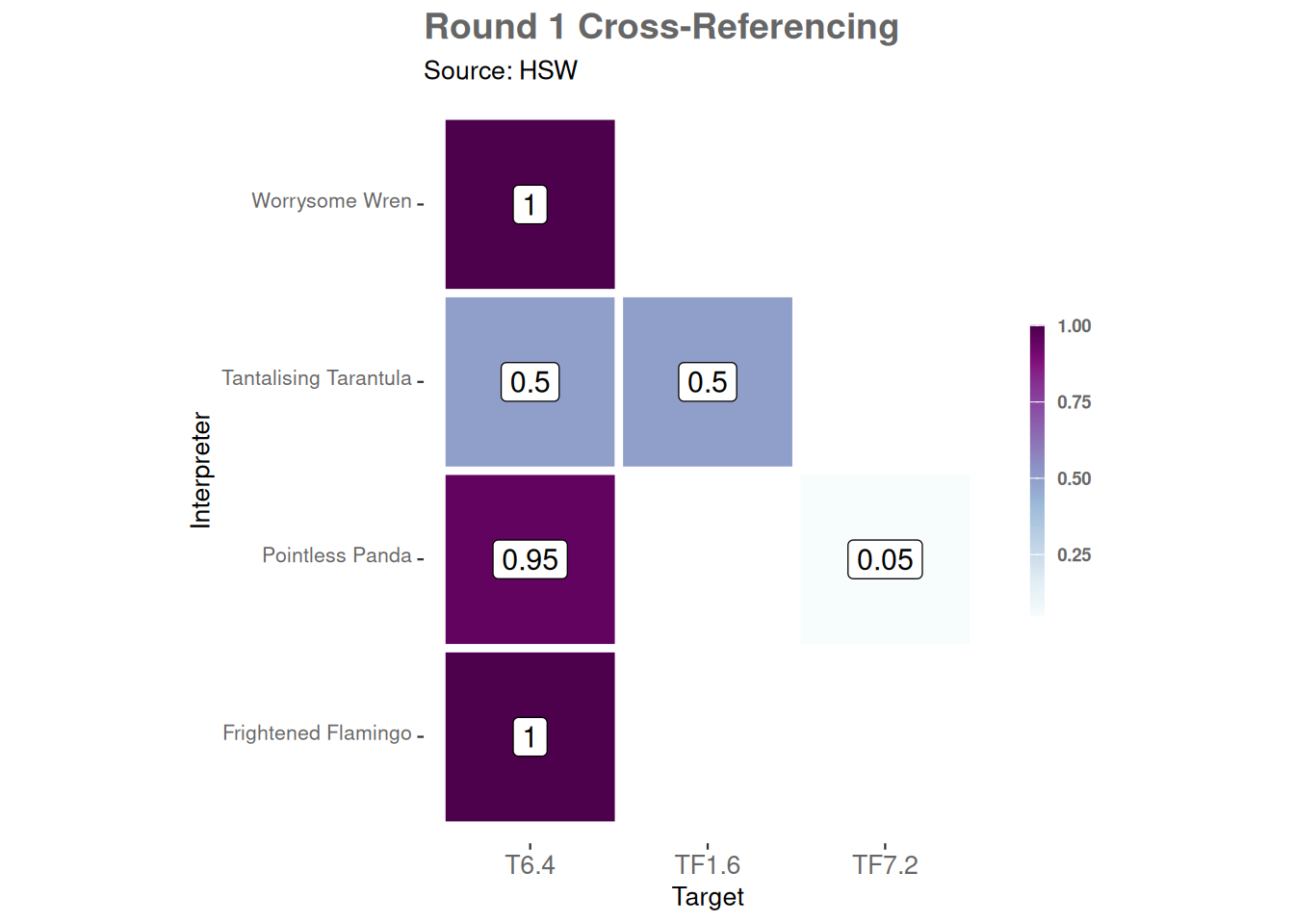
# Alternatively, code the filter in the function:
membership_tile_plot(TASVEG_memb, select_source = "HSW")
#> Error in `membership_tile_plot()`:
#> ! unused argument (select_source = "HSW")
# would internally use:
# sid <- attr(TASVEG_memb,"source_id")
# data <- filter(TASVEG_memb, sid == select_source)