This package is still work in progress, but it is ready for testing! Please provide feedback on any issues, and check back regularly for updates.
The goal of ecoSynthesis is to assist users in the synthesis of cross-referencing information between two classification systems. The examples in this package focus on ecosystem classifications, and specifically on cross-referencing from local classifications to a global standard classification, but functions are designed to work with any pair of classification systems.
The process of cross-reference implies a source classification and a target classification, where the target classification might have a broader scope than the source. Elements in the source classification can be interpreted as directly related to one or more elements in the target classification. This relationship can be quantified as membership values, where the source element has memberships between 0 and 100% to each element of the target classification.
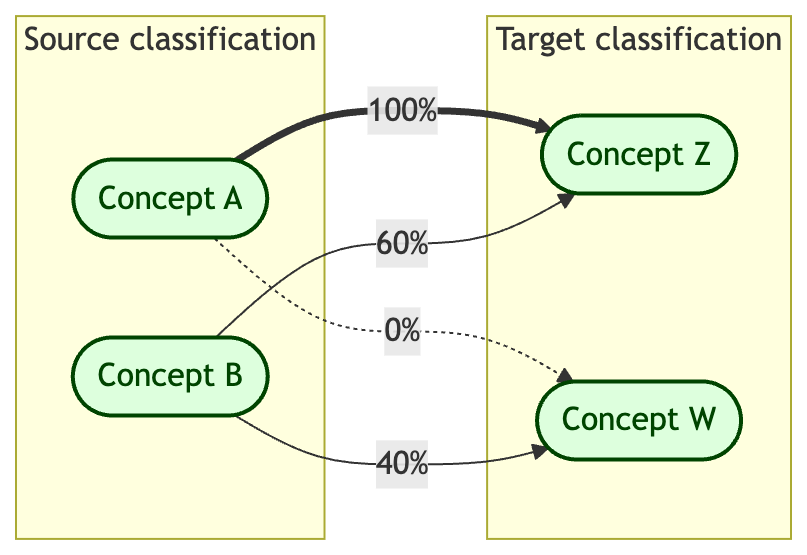
The membership table (long format) looks like this (assuming all other possible pairs have 0% membership).
| Source Classification | Target Classification | Membership |
|---|---|---|
| Concept A | Concept Z | 100% |
| Concept B | Concept W | 60% |
| Concept B | Concept Z | 40% |
Installation
You can install the development version of ecoSynthesis from GitHub with:
# install.packages("pak")
pak::pak("Ecosystem-Indicators-Workflows/ecoSynthesis")
Example
This is a basic example which shows you how to solve a common problem:
library(ecoSynthesis)

input_table <- data.frame(
    types = rep(
        c(
            "Semi-deciduous Forest",
            "Deciduous Forest",
            "Wet Montane Forest",
            "Dry Montane Forest"
        ),
        2
    ),
    groups = c("T1.1", "T1.2", "T1.1", "T1.2", "T1.2", "T1.1", "T1.3", "T1.3"),
    memb = c(0.80, 0.80, 0.70, 0.50, 0.20, 0.20, 0.30, 0.50),
    name = "Parched Porcupine"
)

membership_tbl(
    input_table,
    source = "types",
    target = "groups",
    membership = "memb",
    interpreter = "name"
)
#> <membership_tbl>
#> source_id column: types
#> target_id column: groups
#> membership column: memb
#> interpreter column: name
#>
#> # A tibble: 8 × 4
#>   types                 groups  memb name
#> * <chr>                 <chr>  <dbl> <chr>
#> 1 Semi-deciduous Forest T1.1     0.8 Parched Porcupine
#> 2 Deciduous Forest      T1.2     0.8 Parched Porcupine
#> 3 Wet Montane Forest    T1.1     0.7 Parched Porcupine
#> 4 Dry Montane Forest    T1.2     0.5 Parched Porcupine
#> 5 Semi-deciduous Forest T1.2     0.2 Parched Porcupine
#> 6 Deciduous Forest      T1.1     0.2 Parched Porcupine
#> 7 Wet Montane Forest    T1.3     0.3 Parched Porcupine
#> 8 Dry Montane Forest    T1.3     0.5 Parched Porcupine
This package implements recommended methods from:
IUCN (2025). Standards, methods and guidelines for cross-referencing ecosystem classifications and maps to the IUCN Global Ecosystem Typology. Version 1.0. Keith, D. A., Dayaram, A., Driver, A., Ferrer-Paris, J. R., Francis, R., Hay, S., Murray, N. J., Nicholson, E., Santos, J., Skowno, A. L. & Tozer, M. G. (Eds.). Gland, Switzerland: IUCN. ISBN: 978-2-8317-2348-8. DOI:10.2305/CPPC6126.
This package in in the very early stages of development.
Please find more information about the Environmental Indicators Initiative here; https://ardc.edu.au/project/environmental-indicators-initiative/, and the Ecosystem Indicator Workflows project here; https://ardc.edu.au/project/ecosystem-indicator-workflows/.